What if Ancient Egypt carried its own sacred path of Tantra? A path where breath, serpent energy, sacred union, and spiritual awakening were woven into a single initiatory system?
And what if – for thousands of years – most of this wisdom disappeared, erased from the historical record, or replaced with religious teachings that reframed sexuality as sin, and distanced ordinary people from a direct connection with the divine?
As most people know, the word Tantra is a Sanskrit term. It relates to spiritual teachings that emerged in India roughly 1,200 – 1,500 years ago (based on actual texts), although many scholars believe the practices could be even older. Those that included sexual practices rose between the 7th and 10th century through the Kaula traditions and yogini cults.
Some of the early Tantric movements arose in part because people were seeking a more direct experience of the divine, outside of priest-led ritual systems in Hinduism.
Rather than relying on priests, temples, and formal ceremonies, many Tantric traditions emphasised that the body could become a temple, and that every aspect of life could be part of the spiritual path – including breath, relationships, energy, and yes… sexuality.
This became one of the foundation stones of the often rebellious, unconventional, and at times pretty wild Tantric teachings that later spread and expanded through India.
But now let's look at Egypt. Before we go any further, I want to be clear: there is currently no accepted academic theory that Ancient Egypt had a formal Tantric tradition in the same way India did. What I'm suggesting is something slightly different.
When you walk through the temples of Egypt, when you study the myths, meditate on the symbols, and look beneath the surface of what most tourists see, you begin encountering themes that feel remarkably Tantric:
- Clear and obvious temple images of sacred sexuality.
- Images depicting serpent energy.
- The divinisation of the body.
- And resurrection imagery connected to sacred union.
The deeper I went, the more tantric clues I found… and some go back even earlier than Indian Tantra.
Could Egypt have birthed tantric teachings even earlier than India?
Now I realise that statement might press some people's buttons big time, but bear with me…
Let me share some of the evidence that led me to consider this possibility.
Tantric Clue #1: The Ancient Egyptian Term for Tantra
This concept of an Egyptian Tantra is so hard to find that you have to go deep diving into some of the Ancient Egyptian texts before you begin finding references that point in this direction.
One of the key words I became fascinated with in ancient Egyptian is "Tettetu" – which some translate as "Tantra".
Inside that word is another interesting word: Tet or Djed.
The Djed was a symbol representing the spine.
So Tettetu can be understood as "the meeting of the two spines aligned to the divine," or "the meeting of the two spines aligned to the earth."
In fact, on the temple walls of Ancient Egypt, if you really go hunting (as I did late last year), you'll find images of people sitting spine to spine with one another. The Dendera Temple crypts are the place to find it (it's small, so look closer!).
Why go spine to spine? Because you can support energy to rise, run, and then circulate between two people. It supports a shift into Ka (energy body) activation. It enables people to explore the ancient use of Ankh practices that run energy between the sex, the heart and the soul, either solo or with another person.
With that practice you direct the energy out the back of the heart – through your partner's heart, up and through the two soul points and back into your own heart again. It's an exquisite practice I've not found anywhere else.
Tettetu – the Ancient Egyptian Term for Tantra – Aligning the Two Spines With the Divine
Tantric Clue #2: Hidden (in Plain Sight) in the Myth of Isis and Osiris
In this story, Isis and Osiris are the queen and king of ancient Egypt. As the tale unfolds, Osiris is murdered by his jealous brother Set, who wants to sit on the throne and have the power for himself.
If Osiris is the perfect King, his brother is the shadow opposite.
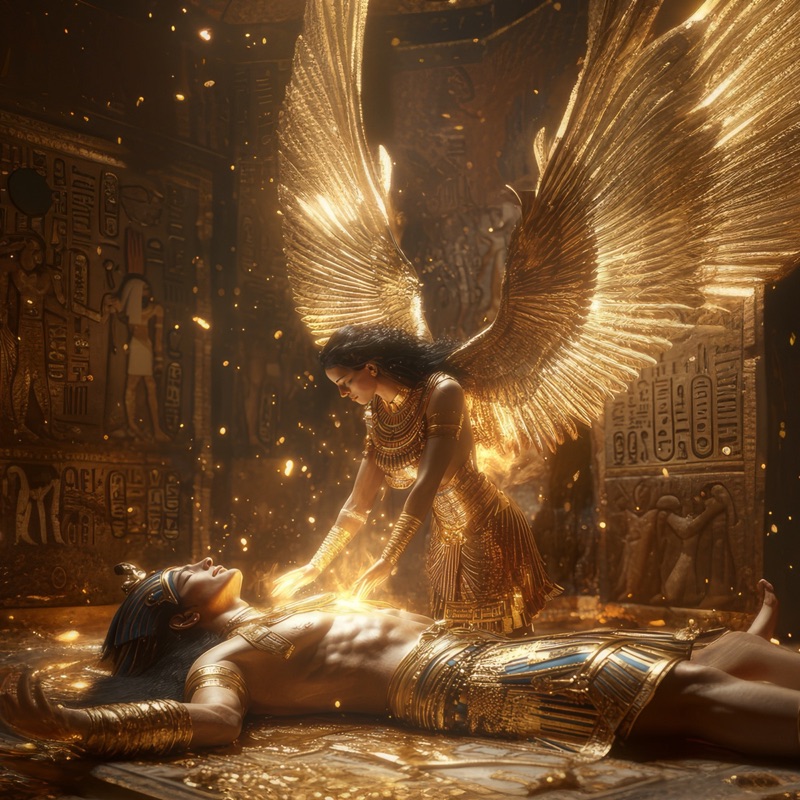
Naturally, Isis is totally heartbroken because the love of her life has been killed. In fact he wasn't just killed, Set chopped him up into 14 pieces and scattered them far across the land. In the end Isis embarks on an epic quest in search of all the parts of Osiris, with the hope that she might be able to magically resurrect him.
She finds 13 of the 14 parts, and there is 1 crucial missing part – can you guess which part? A hand? A foot? Nope.
It's Tantric Clue #2 – his phallus – his sex centre.
What's even stranger in the texts is that the phallus isn't simply lost. It's been eaten by fish with electrical properties!
Pattern Interrupt for the Brain… What?!
In Egypt, they have the electric catfish – the "thunder of the Nile" as it is called – AKA Malapterurus electricus, or to go back to the ancient Egyptian name for it, N'r or Nar.
It's able to give you a 450-volt electric shock if you royally piss it off, and it was used by the Egyptians as the earliest known form of electro-shock therapy.
So inside the Isis and Osiris story, the sex centre is eaten by electric fish… this is a really weird and very specific reference.
I spent time meditating on the idea of it… the deeper meaning behind it… the physicality of sex is gone, and in its place is a symbol connected to electricity. What is it trying to say?
Then I had a massive lightbulb moment:
Oh my God… this is a coded reference to Tantric practices in Egypt!
Let me explain…
When you explore the Tantric path you start activating energy – or as they would call it in ancient Egypt – Sekhem.
Sekhem is the life force – the rising serpent energy known in India as Kundalini.
Temples in Egypt abound with serpents risen to the level of the third eye. Why?
It's coded language – pointing to the secret teachings. The message?
Learn to Raise Your Serpents to the Third Eye
As Jesus said:
If therefore thine eye be single, thy whole body shall be full of light.
The single eye = the third eye.
When you open that serpentine energy, it can rise up the spine and the body can go into a kind of shaking movement that feels and looks electrical in its nature.
From the outside it can look strange, and yet from the inside it can feel extremely pleasurable, ecstatic, even blissful as this energy moves through the body.
Sometimes the shaking comes because there are blockages in the body, and it's trying to clear the energy channels so that Sekhem – Kundalini – can move smoothly through the system.
So it's not just the missing phallus – it's the crucial symbolic electrical clue left in its place. This is Tantric Clue #2.
Tantric Clue #3: The Golden Phallus
At the end of the Isis and Osiris myth, Isis ends up fashioning a phallus out of gold. Actually there are a few different versions – in some she fashions it out of clay, and in others out of gold.
The meaning?
Clay – deeply connected to the earth and this physical realm – "you are of this earth, you are of this nature."
Gold – for the Egyptians was the earthly manifestation of the divine. So in fashioning the phallus out of gold, the message it imparts is:
Your Sexuality Is Divine. It Is Holy. It Is as Golden as Any Other Part of You.
This act of Isis re-membering her beloved, of piecing him back together – golden phallus and all – makes Osiris whole again and allows him to be resurrected.
Isis is not in a passive role here, she's directly and actively involved in the resurrection process of her beloved. She magically helps him come back to life.
Osiris resurrects – he rises… in more ways than one.
These two beloveds are reunited again after so long. What do they do? What do most beloveds do?
They go into lovemaking – yet another Tantric clue – and conceive Horus, the divine child.
These three are some of the most glaring and obvious Tantric clues in ancient Egypt, in my opinion.
But let's not stop there, because there's another biggie that appears throughout Egypt's temples…
Tantric Clue #4: Egypt's Fertility God
Egypt's ancient fertility god is known as Min, and he's so ancient he goes right back to pre-dynastic times. He's depicted through so many of the Egyptian temples with an erect phallus.
Thousands of years later, when the Romans and later Christianity took over Egypt, they began to embrace the worldview that sex is a sin, and those phalluses – once venerated in ancient Egypt – were targeted and erased, chipped away by offended Christians…
Although they kind of failed. Because in some temples, lower images were removed, but higher up on the walls, where it was harder to reach, those phalluses still remain.
Tantric clues hidden in plain sight?
I say all this not to suggest these Egyptian Tantric teachings are somehow "better" than Indian tantric teachings.
Let's zoom out and recognise: whilst India had Tantra, China had the Taoist sexual teachings, which were closely guarded secrets. In fact, many of those teachings only became publicly known through Mantak Chia's work since the 1970s.
So the interesting thing about the time we are living in is that these teachings are becoming more and more available from many different lineages…
- Tantric lineages,
- Taoist lineages,
- and the Egyptian Tettetu lineage.
But because almost no one has even the faintest clue about the word Tettetu and its deeper meaning, in my body of work I continue to use the term "Egyptian Tantra".
Yes, it might piss some classical tantrics off, sorry folks.
But those who are open minded enough to look a little deeper… oh my goddess, there is a whole universe of powerful spiritual practices to explore in and through the Egyptian Tantric Secrets.
If you want to find out more about Egyptian Tantra, click the link below.
Or nestle spine to spine – Djed to Djed – with your beloved tonight, start breathing deeply, and see what happens!